
There was a time when digital advertising was fairly simple.
A customer searched for something on Google, saw a few advertisements, clicked on one, visited a website and perhaps filled out a form.
Then social media changed the game.
People started discovering brands while scrolling through Instagram, YouTube, Facebook and other platforms. Advertising became less about waiting for someone to search and more about appearing in front of the right person at the right moment.
Now another shift is happening.
The next advertising battlefield may be the AI conversation itself.
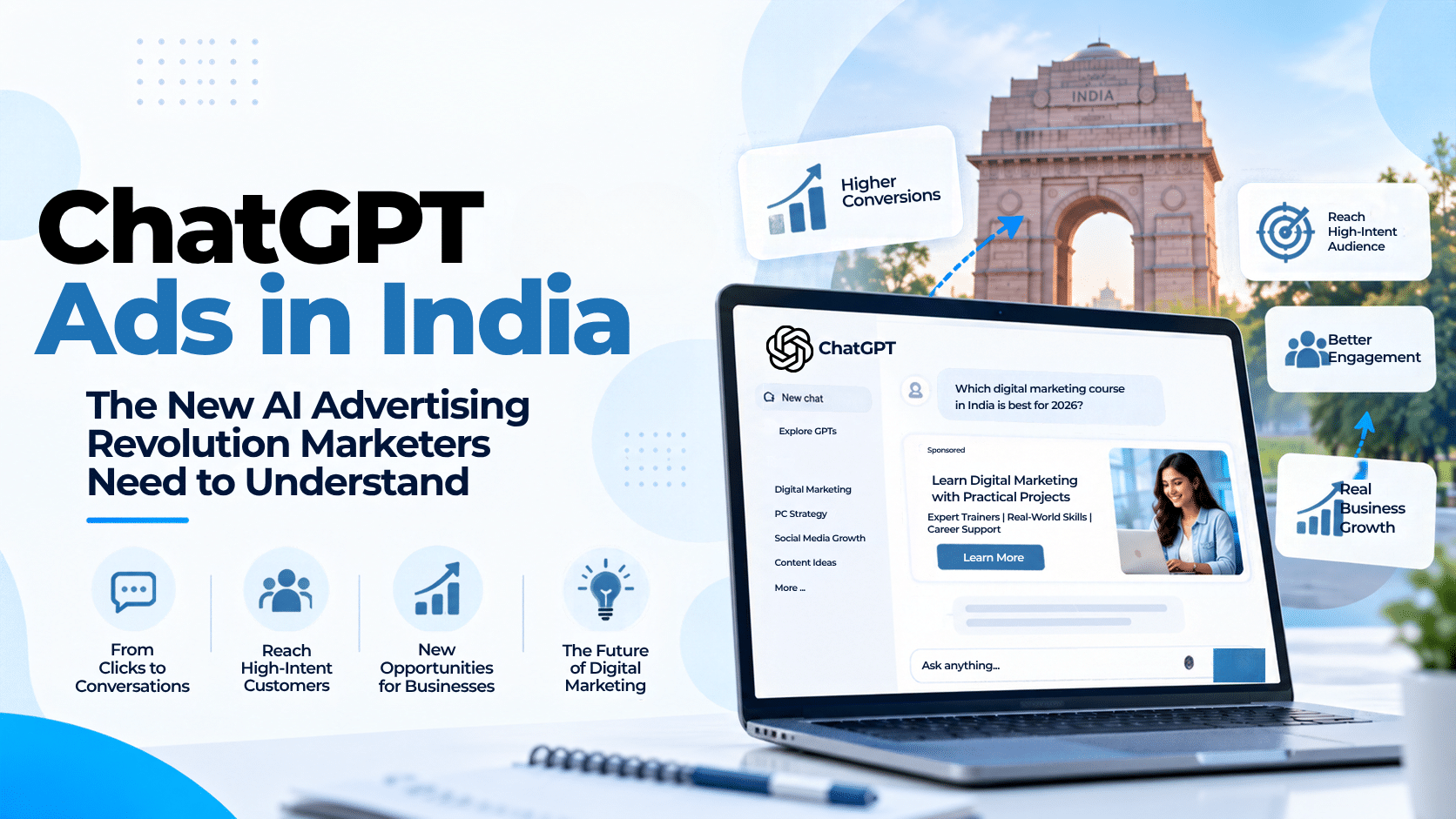
ChatGPT Ads are expanding into more markets, including India, while OpenAI is testing new advertising experiences that allow businesses to engage potential customers through AI-powered conversations. OpenAI says ChatGPT Ads are now available in more than 60 countries, following expansion across Asia and other regions.
For Indian businesses, marketers and digital marketing professionals, this raises an important question:
What happens when customers stop simply clicking advertisements and start talking to them?
What Are ChatGPT Ads?
ChatGPT Ads are an emerging form of advertising designed around the way people use conversational AI.
Traditional digital ads generally try to persuade someone to click.
AI-powered advertising can potentially do something different: help a person explore a product, compare options, ask questions and understand whether an offering fits their needs.
That distinction is important.
Imagine someone asking an AI assistant:
“I need a digital marketing course in Delhi that includes practical projects.”
Instead of receiving only a list of advertisements, the future of advertising could involve a more conversational experience where a business can answer questions and guide the potential customer.
That is where AI advertising starts becoming more than another banner or sponsored search result.
It becomes part of the decision-making journey.
Why ChatGPT Ads Matter for Indian Businesses
India has one of the world’s most competitive digital markets.
A small business in Delhi can compete for attention with companies from Mumbai, Bengaluru, Hyderabad or even international brands. At the same time, consumers have more choices than ever.
This creates a familiar problem:
Getting attention is becoming harder.
Businesses are therefore looking for channels where customers are already asking questions and expressing intent.
AI platforms are interesting because users often approach them with highly specific problems.
They don’t necessarily say:
“Show me an advertisement.”
They say:
“Which laptop should I buy for video editing?”
“How can I learn SEO?”
“Which software is suitable for my small business?”
“What is the best way to run Facebook ads?”
These are not just searches.
They are conversations.
And conversations contain context.
That could make conversational advertising particularly interesting for marketers.
The Biggest Change: From Clicks to Conversations
For years, marketers have obsessed over metrics such as:
- Impressions
- Click-through rate
- Cost per click
- Conversion rate
- Cost per lead
Those numbers aren’t disappearing.
But AI could add another layer to the customer journey.
Instead of a person clicking an advertisement and immediately landing on a sales page, an AI-powered advertising experience could allow the person to interact with a business before making a decision.
OpenAI is currently testing Sponsored Agents, which can allow users to start a conversation with a business-sponsored agent after interacting with an advertisement. OpenAI describes this as a distinct experience from ChatGPT’s independent answers.
Think about the difference.
Traditional advertising
Ad → Landing page → Form → Sales team
Conversational advertising
Ad → Conversation → Questions → Product understanding → Potential action
The second model could be particularly useful for products and services that require explanation.
Education is one example.
Insurance is another.
Software, financial services, travel, healthcare-related information, professional services and B2B products can also involve considerable research before a customer takes action.
ChatGPT Ads Are Not Just Another Google Ads Alternative
It would be tempting to look at ChatGPT Ads and simply say:
“It’s another place to buy ads.”
That may miss the bigger picture.
Google Search primarily captures search intent.
Social platforms are excellent at discovery and interest-based engagement.
Conversational AI introduces another environment: question-driven exploration.
The user can explain what they want in considerable detail.
For marketers, that means understanding natural language and customer problems could become increasingly important.
A good advertisement may no longer be enough.
Businesses will need to think about what happens after the advertisement gets attention.
What About SEO?
This is where things get particularly interesting for website owners.
Google says AI Overviews and AI Mode are already being used at very large scale. Google reported in August 2026 that AI Overviews had more than 2.5 billion monthly active users, while AI Mode had surpassed one billion monthly users. Google has also said it is adding more links and website previews to its AI Search experiences.
So there are now two related developments happening:
Search is becoming more conversational.
Advertising is becoming more conversational.
That changes the job of SEO.
Publishing a page simply because a keyword has high search volume is becoming less useful as a complete strategy.
Businesses need content that actually answers questions.
They need clear explanations.
They need original information.
They need strong credibility.
And they need to demonstrate genuine expertise.
Google’s current documentation also makes it clear that its spam policies apply to generative AI responses in Search. Google has specifically clarified that llms.txt is not required for Google Search and does not provide a ranking advantage.
In other words, marketers shouldn’t chase every new AI acronym they see on LinkedIn.
The fundamentals still matter.
The Rise of Answer-First Content
One of the biggest changes marketers should pay attention to is how people consume information.
Previously, a company might create an article around a keyword such as:
“Digital Marketing Course in Delhi.”
Now the same customer might ask:
“Which digital marketing skills should I learn in 2026 if I want a job?”
Those are very different queries.
The second question is more conversational, more specific and closer to a real problem.
This is why content creators should start thinking beyond keywords.
Ask:
What question is my customer actually trying to solve?
Then create content that solves it.
That doesn’t mean abandoning SEO.
It means combining SEO with useful, genuinely helpful content.
What Small Businesses Should Do Now
You don’t need a huge advertising budget to prepare for this change.
In fact, small businesses can start with the basics.
1. Make your website genuinely useful
Don’t make every page a sales pitch.
Create pages that answer the questions your customers repeatedly ask.
If you run a coaching institute, explain course selection, career paths, skills, salaries, learning timelines and common mistakes.
If you run an e-commerce store, create useful buying guides.
If you provide professional services, explain the problems you solve.
Useful information gives AI systems and humans something meaningful to understand.
2. Build a recognisable brand
AI-powered discovery does not mean branding becomes irrelevant.
Quite the opposite.
When people encounter your company through different channels, they should be able to recognise who you are, what you do and why your business exists.
Your website, social profiles, reviews, videos and content should tell a consistent story.
3. Stop writing for algorithms alone
This is probably one of the biggest lessons for content marketers.
A 2,000-word article isn’t automatically valuable because it is 2,000 words long.
Adding the same keyword 30 times doesn’t make an article authoritative.
And using AI to produce hundreds of nearly identical articles isn’t a sustainable content strategy.
Google’s guidance continues to emphasise quality and spam policies even as generative AI becomes part of Search.
Write for the person who has the problem.
The algorithm comes second.
4. Experiment with short-form video
Written content isn’t the only format becoming important.
Social media trends in 2026 continue to point toward short-form video, creator-led content, AI-assisted production and more authentic forms of audience interaction.
A business should therefore think about one idea in multiple formats.
For example:
Blog: How to choose a digital marketing course
Instagram Reel: 3 mistakes students make when choosing a course
YouTube Short: Skills every digital marketer needs in 2026
LinkedIn post: Why digital marketing jobs are changing
One idea can become an entire content ecosystem.
Will AI Replace Digital Marketers?
Probably not in the way many headlines suggest.
But it will change what digital marketers spend their time doing.
AI is increasingly capable of helping with research, content creation, analysis, campaign workflows and creative development.
The human advantage will increasingly come from strategy.
Knowing what to say, who to say it to, why it matters, and which business problem should be solved is still fundamentally strategic work.
OpenAI’s latest advertising developments reflect this shift. The company says it is introducing AI creative tools for advertisers and integrations with platforms such as HubSpot and Shopify, while testing Sponsored Agents.
The tools are becoming smarter.
That doesn’t eliminate the need for marketers.
It raises the value of marketers who know how to use those tools properly.
What ChatGPT Ads Could Mean for Digital Marketing Careers
For digital marketing students and professionals, this is an important development.
The traditional skill set included:
- SEO
- Google Ads
- Social media marketing
- Content marketing
- Email marketing
- Analytics
- Copywriting
Those skills still matter.
But the next layer is likely to include:
- AI-assisted content strategy
- Conversational marketing
- AI search optimisation
- Prompt-based workflows
- Marketing automation
- Customer journey design
- AI analytics
- First-party data strategy
This doesn’t mean everyone needs to become an AI engineer.
A marketer who understands customers, platforms, content and data — and can use AI effectively — can potentially become much more productive.
The Bigger Picture
The interesting thing about ChatGPT Ads isn’t simply that another company has entered the advertising market.
The bigger story is that the interface between customers and businesses is changing.
First, we had websites.
Then search engines became the primary gateway to information.
Then social media feeds became major discovery engines.
Now conversational AI is becoming another way people explore ideas, products and services.
Each shift has changed marketing.
AI will likely do the same.
But businesses shouldn’t respond by throwing their entire marketing strategy into the latest trend.
The smarter approach is to strengthen the basics while experimenting with new channels.
Build a useful website.
Create original content.
Understand your customers.
Develop a recognisable brand.
Collect meaningful first-party data.
Use analytics.
Learn how AI search works.
And keep testing new ways of reaching people.
Final Thoughts
ChatGPT Ads are still a developing advertising channel, so nobody can honestly say exactly what the market will look like several years from now.
But the direction is already interesting.
Advertising is moving closer to the moment when people ask questions and make decisions.
Search is becoming more conversational.
AI platforms are becoming more capable of understanding context.
And businesses are getting new opportunities to interact with potential customers.
For digital marketers, the lesson is simple:
Don’t just learn how to create advertisements. Learn how customers think, search, ask questions and make decisions.
The platforms will keep changing.
The fundamentals of understanding people won’t.
Frequently Asked Questions
What are ChatGPT Ads?
ChatGPT Ads are advertising experiences designed for ChatGPT and its conversational environment. OpenAI has expanded its advertising platform internationally and is developing new formats designed to help businesses reach users during product and service discovery.
Are ChatGPT Ads available in India?
Yes. OpenAI announced that ChatGPT Ads had expanded to India alongside several other markets.
Will ChatGPT Ads replace Google Ads?
There is no evidence that ChatGPT Ads are replacing Google Ads. They represent a different advertising environment built around conversational AI. Businesses should evaluate each channel according to their audience, objectives, costs and results.
Will SEO still matter because of AI?
Yes. Search is evolving, but websites and useful web content remain important. Google says its AI Search experiences are designed to help people discover and visit websites, while also providing new guidance and controls for website owners.
Should small businesses start using AI in marketing?
AI can be useful for research, content workflows, analysis, customer-service processes and creative development. However, businesses should use it as part of a broader marketing strategy rather than treating AI itself as the strategy.
What should digital marketing students learn in 2026?
Along with traditional skills such as SEO, PPC, social media, content and analytics, students should become comfortable with AI-assisted workflows, conversational search, automation, data analysis and customer journey strategy.